
Sources for Broomfield Previous Residents
A past-resident search has two tracks. Ownership history follows parcels and recorded instruments. Household history follows directories, census schedules, newspapers, cemeteries, and family or probate sources. The first track is usually strongest for the modern period. The second becomes more useful as the address moves into the telephone-book and directory era.
| Source | Years it covers | Where held | What it shows |
|---|---|---|---|
| Broomfield recorder EagleWeb | 11/15/2001 to current indexed range | Recording Division | Deed parties, dates, document types, legal descriptions |
| Assessor card and transfers | Current account; sample reaches 04/27/1990 | Broomfield Assessor | Owner, mailing, situs, parcel, transfers, tax context |
| DPL criss-cross directories | 1924-2018; digital 1924-1937 subset | Denver Public Library | Street-to-occupant or subscriber clues |
| Local telephone directory | Spring 1960 | Broomfield History Collections | Broomfield, Broomfield Heights, East Lake listings |
| LOC telephone books | 1944, 1945, 1946, 1948, 1950, 1958, 1960, 1970, 1974 | Library of Congress | Subscriber name, street address, number |
| Boulder directory references | 1926, 1928, 1930, 1932 | National Archives table | Broomfield locality leads inside broader volumes |
| Federal census | Through the 1950 release | NARA and library databases | Household structure, age, birthplace, broad trade |
| Newspaper and obituary | CHNC through 1923; Enterprise 1999-present or historic | Library databases and CHNC | Events, relatives, former addresses, cemetery clues |
| Probate and cemetery | File or interment year | Combined Courts or city route | Heirs, representatives, interment, lot, memorial |
Begin with the era you need. A modern deed chain does not replace a 1960 directory. A telephone entry does not replace a deed. A cemetery record does not replace a restricted death certificate. The best previous-residents trail names the source type and its limits.
Stabilize a Broomfield Parcel for Previous Residents
Choose one current address and preserve its account number, parcel number, legal description, subdivision, lot, block, tract, unit, every situs line, and owner mailing address. The sample One DesCombes account returned a municipal parcel with three situs lines and a separate solar account. That kind of duplication can make a street string look like several unrelated properties.
Use the assessor card to create the parcel anchor. Copy the current owner and transfer history, but do not call the owner a confirmed occupant. Open the GIS map to check adjacent or common-area geometry. Then use the legal description in the recorder. A legal description survives an address-label change better than a street spelling.
Broomfield assessor search is the place to save the current parcel record before working backward.
Broomfield Recorder Records for Previous Residents
Broomfield EagleWeb's recorded-document index begins on November 15, 2001, the date the consolidated City and County of Broomfield began. The form accepts document number, date range, grantor, grantee, both names, subdivision, lot, block, tract, unit, survey fields, and document type. A deed, release, lien, plat, easement, covenant, or correction can supply a different part of the chain.
Guest users can see the index, but image access and certified copies have separate paths. The Recording Division lists in-person, mail, drop-off, and e-recording channels. The current June 1, 2026 fee schedule lists $43 for a general recorded document, $0.25 per copy page, and $1 for certification per document, with other document-specific charges.
The Broomfield recorder index is the modern starting point. The office will not conduct a general search for a requester under C.R.S. 30-10-101(2.5)(c), so arrive with the parcel, legal description, name, date, or document number.
The Broomfield recorded-document sample is the image source for the party, date, number, and legal-summary example.
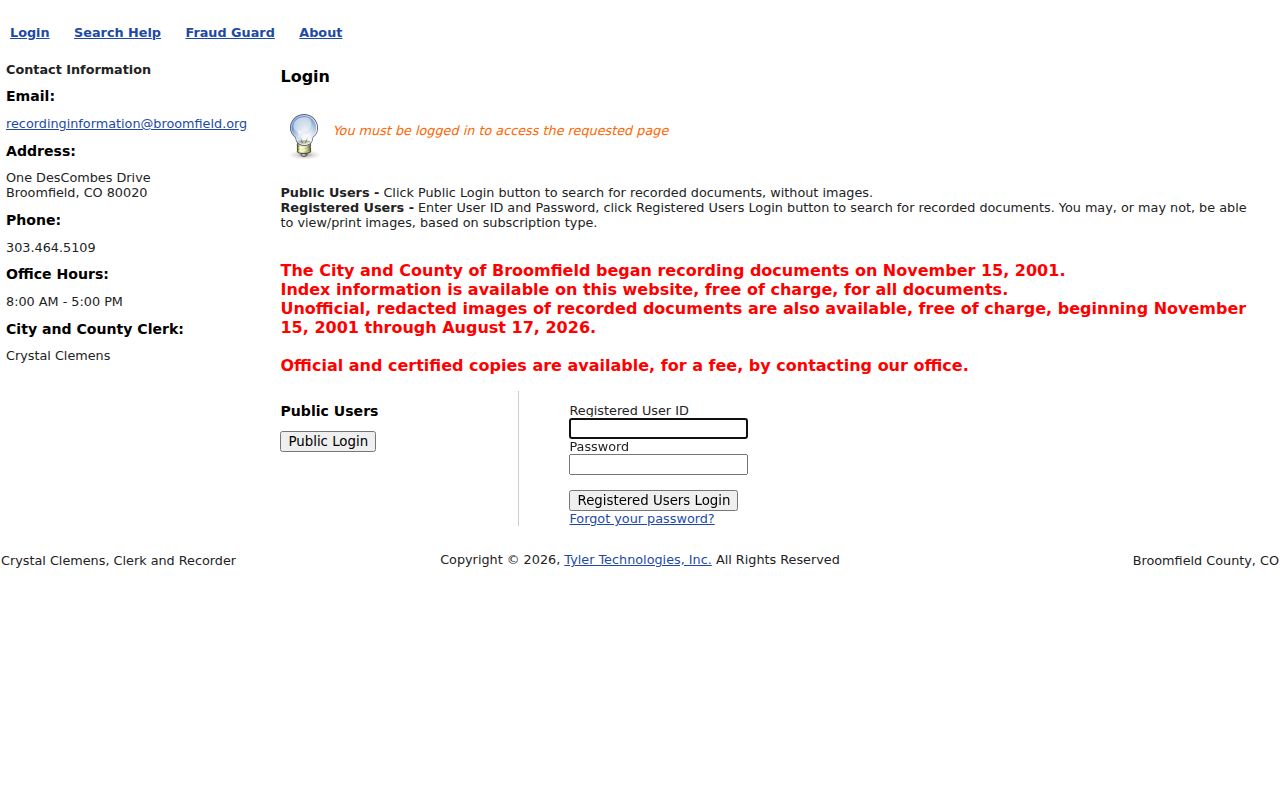
The recorded-document sample shows the party, date, number, legal summary, and related-document handoff used in a backward chain.
Trace Broomfield Past Residents Through Deeds
Grantor means the person or entity transferring an interest. Grantee means the person or entity receiving it. A chain of title is the sequence of instruments that connects one recorded interest to an earlier one. A legal description identifies the land more reliably than a current street label.
- Open the current assessor card and copy the owner, parcel, legal description, situs, and transfer lines.
- Search the recorder by subdivision, lot, block, or legal description before broadening to a name-only search.
- Copy the latest deed number, date, grantor, grantee, document type, legal summary, and related documents.
- Search the current grantor as an earlier grantee, then repeat the same handoff through the prior instrument.
- Stop at November 15, 2001 and move the older legal description to the former county that held the record.
Use the assessor transfer history as a check, not as the sole title source. It may show an older date, consideration, or document description while abbreviating parties. The recorder index is the document-number route. A certified copy must come from Broomfield or the former county custodian.
- Grantor
- The party transferring an interest in a recorded instrument.
- Grantee
- The party receiving an interest in a recorded instrument.
- Chain of title
- The sequence of recorded instruments connecting a current interest to earlier interests.
- Legal description
- Subdivision, lot, block, tract, unit, or survey language that identifies the land.
Four Counties in Broomfield Previous-Resident Research
Before Broomfield County, the same territory was divided among Adams, Boulder, Jefferson, and Weld Counties. That four-county branch is the key to previous residents research. A pre-2001 deed, plat, marriage record, court file, census label, or directory entry may use a former county even when the current parcel is clearly inside Broomfield.
Keep the exact legal description, approximate date, subdivision, lot, block, and original locality. Search the former county recorder, clerk, archives, and historical society as appropriate. Do not assume that the consolidated EagleWeb index reaches backward simply because the current assessor card contains an older transfer line.
The boundary story also affects the household layer. A 1930 directory or census may call a place Boulder. That label describes the record's geography, not a mistake in the present address.
Broomfield Criss-Cross Books for Previous Residents
The Spring 1960 Broomfield Telephone Directory is a local physical object covering Broomfield, Broomfield Heights, and East Lake. The Library of Congress has selected Broomfield telephone books from 1944, 1945, 1946, 1948, 1950, 1958, 1960, 1970, and 1974. A white-pages entry can show surname, address, and number, while the 1948 and 1950 books also contain yellow-page material.
Denver Public Library's criss-cross run reverses the key to street and number first. Its broad range is 1924 to 2018, with a 1924 to 1937 digital subset. Confirm Broomfield's locality in each volume. A telephone subscriber is not every occupant. A missing listing can mean an unlisted number, a moved household, a spelling change, or a gap in the collection.
The Broomfield city directory collection page explains how to read these books, compare years, and record a precise citation.
Denver Public Library's house-history methods place criss-cross directories beside maps, census, newspapers, permits, and deeds.
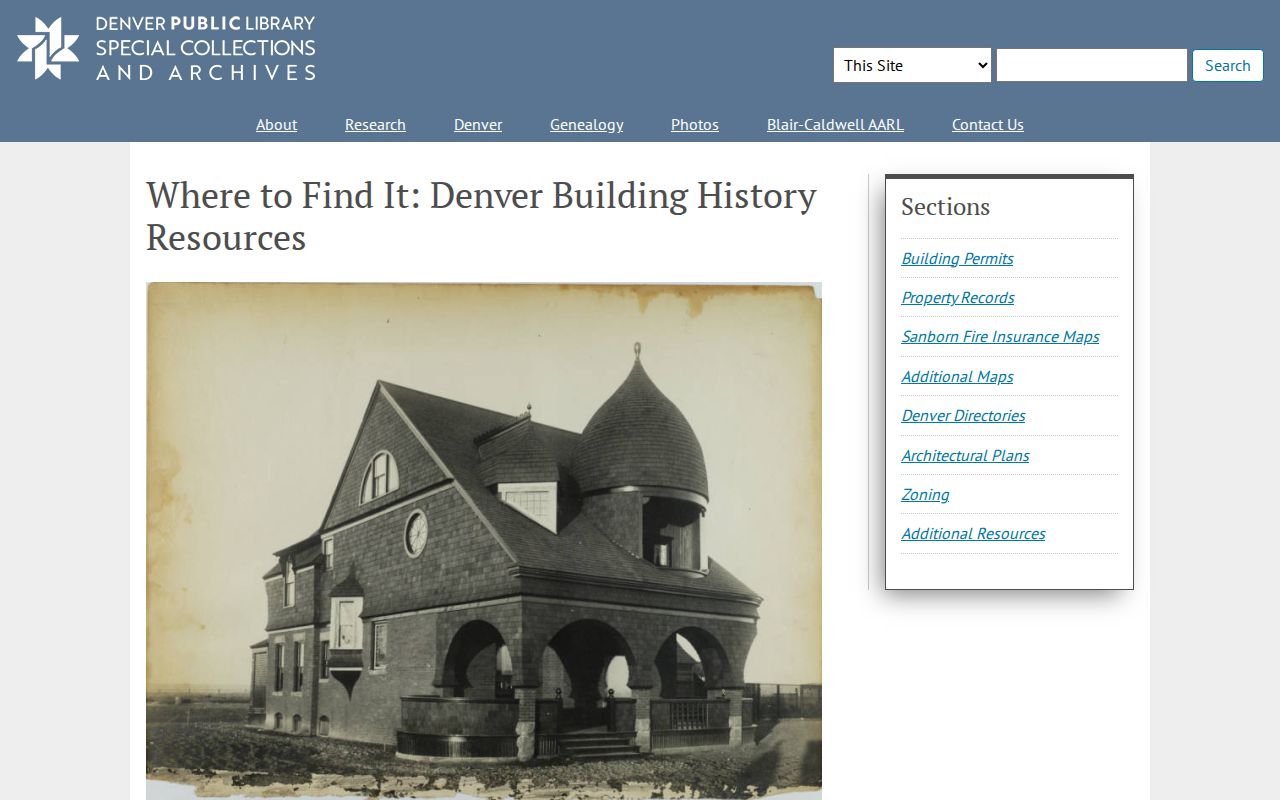
The guide image shows the cross-source method needed when a directory year supplies an address but not a full household story.
Broomfield Previous Residents with Census and Newspapers
Federal census schedules fill in household structure for released years. The 1950 census is available under the 72-year rule, and earlier schedules can add age, birthplace, household members, and broad trade categories. Pair a census with the directory year before or after it. County and township labels follow the census date, so modern Broomfield may not be named.
Pairing flow: directory year → locality and address → nearest released census → dated newspaper, deed, or cemetery check.
Newspapers add event dates and relationships. The Colorado Historic Newspapers Collection reaches through 1923. Broomfield Enterprise routes cover 1999 to the present or historic archive material. Search social columns, school notices, civic groups, marriages, deaths, reunions, and former addresses. Record publication title, date, page, and the exact archive route.
Denver Public Library's building-history guide recommends combining directories, criss-cross, maps and atlases, Sanborn maps where verified, census, newspapers, permits, and deeds. It describes a Denver collection method, not proof that a Broomfield map sheet exists. Keep unverified Broomfield map years marked as a gap.
The Denver building and neighborhood history route supplies the regional criss-cross and place-history context.
The neighborhood-history image connects an older address to maps and directory methods without inventing a local Sanborn coverage year.
Vaughan's Broomfield Previous-Resident Model
Broomfield History Collections catalogs a March 6, 2013 Vaughan family and Broomfield Depot genealogy report. Its description pairs census, directories, Denver Public Library, newspapers, and World War I draft registrations. That source mix is a useful local model for previous residents research because it joins an address or family name to several record classes.
The report does not create a public list of every Broomfield household. It demonstrates the value of a targeted request to the museum or curator after a name, date, place, depot connection, or family clue is known. Ask for the item identifier, the cited sources, and the access terms.
The Vaughan report CatalogIt entry is the source for this interest-layer example.
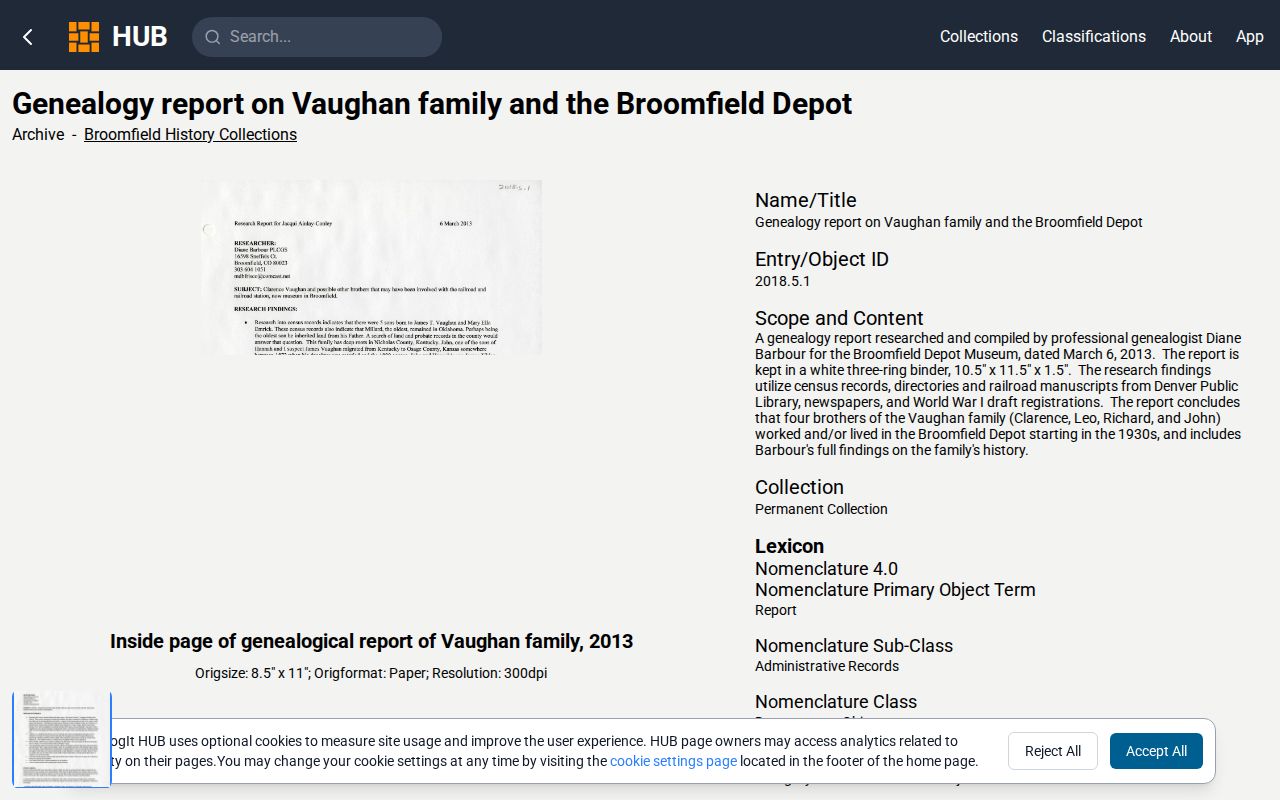
The catalog image shows how a local history object can bridge a directory, census, newspaper, and family-history question.
Broomfield Previous Residents at Record Endpoints
A newspaper death notice can name survivors, a former address, funeral home, cemetery, and service date. Lakeview Cemetery preserves an older trail reaching to October 1888, while County Commons begins a modern phase in 2003 and added Phase 2 in 2018. No complete public cemetery name index was located, so ask staff or volunteers with an exact name, lot, block, or date.
Probate can close a household trail with a will, petition, letters, claims, closing paper, heir, representative, or date of death. Broomfield Combined Courts and the statewide request form are the custodian routes. Sealed or confidential probate material may require identity or eligibility. A restricted death certificate is a separate vital-record request.
These endpoints can identify a former resident or family relationship without exposing a current person's address. Preserve the source date and stop when the record becomes restricted.
Broomfield Previous-Resident Address Gaps
Official research did not locate a verified Broomfield street-renumbering or street-renaming table with a year. When a directory, deed, or assessor search misses a prior name, do not invent a conversion. Preserve the legal description and parcel, test alternate suffix and direction forms, inspect every situs line, check the former county, and search the locality index.
A map, plat, directory, tax card, or deed may supply a different kind of continuity. A current street label may not be the right historical key. The absence of a name after one string search is a research gap, not evidence that no one lived there.
Lawful Use for Broomfield Previous Residents
Previous residents research is appropriate for house history, genealogy, estate questions, civic history, and personal curiosity. A deed chain describes recorded interests. A directory describes a listed household or subscriber. A census describes a released household schedule. A newspaper describes a published event. Keeping those categories separate protects both accuracy and privacy.
Personal and lawful use. Do not use a historical address trail to track, watch, harass, intimidate, or harm a living person. Protected records and confidential addresses should remain protected.
When a question shifts to a current named person, use a separate lawful resident lookup and verify the record with its custodian. When it stays with the property, the Broomfield street directory supplies the current parcel and address chain.